Brachymetatarsia (Short Toe)
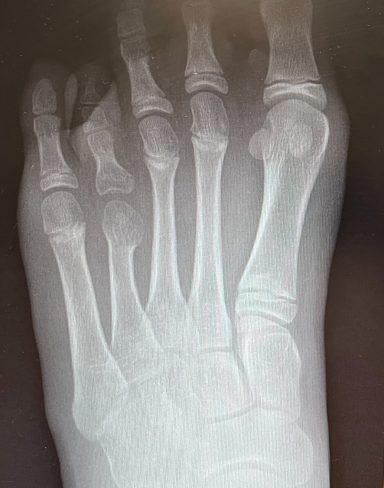
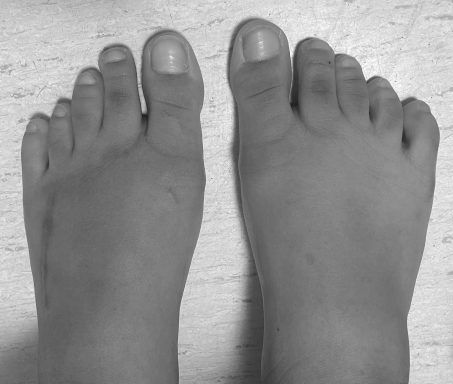
Brachymetatarsia is a condition in which one or more of the long bones of the forefoot (the metatarsals) is abnormally short. The toe attached to it looks short and often sits higher than its neighbours. The fourth metatarsal is most commonly affected. Footwear can ease discomfort, but only surgery can correct the length of the bone.
The five metatarsals run from the middle of the foot to the base of each toe. In brachymetatarsia, one of them stops growing early, so it ends up shorter than the bones around it. The toe it supports is pulled back and often rides up. Jones and colleagues describe it as a cosmetic concern that can also become physically symptomatic. The raised toe can rub against shoes. A review of 62 studies (Córdoba-Fernández and Vera-Gómez, Orthopaedic Nursing) describes brachymetatarsia as resulting from early closure of the growth plate of the affected metatarsal.
Who gets it, and what causes it?
The cause is not fully understood, but it involves stunted growth of the metatarsal. It is present from birth. It may be related to injury, and it can affect family members across generations.
The Córdoba-Fernández review states that it is generally congenital. The published reviews agree that it is far more common in women; two report that the fourth metatarsal is affected most often, followed by the first. The figures vary between reviews:
- Ratio of women to men: 14.8 to 1 (Arceri and colleagues, Journal of Orthopaedics), 13.7 to 1 (Jones and colleagues, The Journal of Foot & Ankle Surgery) and 10.5 to 1 (Córdoba-Fernández and Vera-Gómez)
- Both feet affected: 25.8% of cases (Arceri), 44.5% (Jones) and 47% (Córdoba-Fernández)
What are the symptoms?
- A noticeably shorter or raised toe
- Discomfort from the toe pressing against shoes
- Self-consciousness about the appearance of the foot
- Avoiding open-toed shoes entirely
The Córdoba-Fernández review notes that treatment should take account of the psychological and social impact on the individual, as well as the physical symptoms.
How is it assessed?
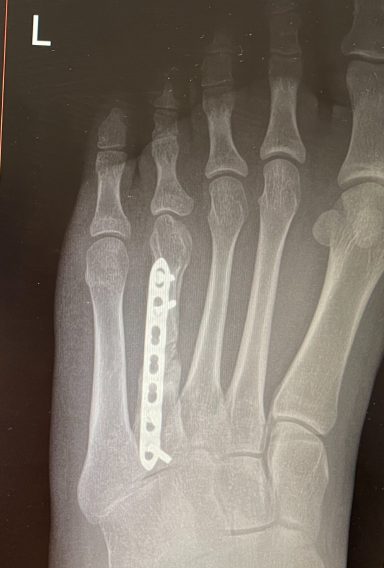
Brachymetatarsia is usually apparent on examination of the foot. Weight-bearing X-rays show which metatarsal is short and by how much, and help to plan any lengthening.
Can it be treated without surgery?
Wearing roomy, deep shoes can accommodate the toe and reduce rubbing. Surgery is the only way to correct the length of the bone.
What does surgery involve?
There are two main approaches.
Single-stage lengthening: the bone is cut and lengthened using a bone graft, which may come from the patient, from a bone bank or be artificial bone. Specially designed screws and plates hold the lengthened bone in place until it heals. The plate and screws are not routinely removed.
External fixator (gradual lengthening): a frame is attached to the bone with specialist wires. The bone is cut and then slowly lengthened over a few weeks by turning dials on the fixator each day. The fixator stays in place for three to six months, until X-rays confirm that the bone has healed.
What does the research show?
A systematic review of 61 studies (Jones and colleagues) compared the two approaches. Gradual lengthening achieved a mean gain of 17.5 mm, compared with 13.2 mm after single-stage lengthening. Major complications were reported in 12.6% after gradual lengthening and 3.7% after single-stage lengthening. Minor complications were reported in 39.2% and 15.8%. Mean healing time was 16.0 weeks after gradual lengthening and 9.4 weeks after single-stage lengthening. The authors concluded that gradual lengthening gains more length but has more complications and takes almost twice as long to heal.
A later systematic review of 13 studies of congenital brachymetatarsia (Arceri and colleagues) reached a similar view. Single-stage lengthening gave limited length gain with fewer complications. Gradual lengthening gave greater length with a higher complication rate, including partial dislocation of the toe joints, fractures and infection. Lengthening of the first metatarsal was associated with more stiffness, fractures and a high-arched foot. The authors found that no single technique could be called the gold standard and recommended a careful case-by-case assessment.
What is recovery like?
After single-stage lengthening:
- 0–6 weeks: cast; no weight-bearing until the bone shows signs of healing (consolidation)
- 6–10 weeks: walking boot; partial weight-bearing
- 10 weeks: move into trainers; swelling continues to settle
- Up to 1 year: full healing; toe stiffness may need therapy to restore movement
With the external fixator method, the fixator may stay on for three to six months before it is removed.
How Mr Hester can help
Mr Hester is a dual fellowship-trained foot and ankle surgeon (FRCS Tr&Orth), trained at Guy's and St Thomas' and in Toronto and Calgary, and a member of BOFAS and EFAS. He sees patients privately at The London Clinic, Cromwell Hospital, King Edward VII's Hospital and HCA The Shard. His NHS practice is at King's College Hospital.
Insured patients need a GP referral and an authorisation code from their insurer. Self-pay patients are welcome. To book, call 020 7046 8004.
Frequently Asked Questions
Sources
- Arceri A, Mazzotti A, Zielli SO, Artioli E, Viroli G, Traversari M, Ruffilli A, Faldini C. What's the evidence on surgical treatment for congenital brachymetatarsia: a systematic review and meta-analysis. Journal of Orthopaedics. https://doi.org/10.1016/j.jor.2023.11.046
- Jones MD, Pinegar DM, Rincker SA. Callus distraction versus single-stage lengthening with bone graft for treatment of brachymetatarsia: a systematic review. The Journal of Foot & Ankle Surgery. https://doi.org/10.1053/j.jfas.2015.02.013
- Córdoba-Fernández A, Vera-Gómez ML. Literature review on brachymetatarsia. Orthopaedic Nursing. https://doi.org/10.1097/NOR.0000000000000487
Kit I recommendالعدّة التي أوصي بها
Items patients often find useful. Always follow your surgical team's instructions; these are general suggestions, not medical advice.عناصر يجدها المرضى مفيدة غالباً. اتبع دائماً تعليمات فريقك الجراحي؛ هذه اقتراحات عامة وليست بديلاً عن المشورة الطبية.
- Post-operative shoe — Stiff-soled shoe for the early weeks after forefoot surgery, if advised
- Crutches — For the period when you need to keep weight off the foot
- Leg elevation pillow — Helps keep the foot raised while resting
- Waterproof cast cover (foot) — Keeps a foot dressing or boot dry in the shower
- Bed blanket support — Holds bedclothes off the operated foot at night
See all recommended equipment on Equipment & Devices.
To discuss your condition with Mr Hester, please get in touch to arrange a consultation.لمناقشة حالتك مع السيد هيستر، يرجى التواصل معنا لترتيب استشارة.
Book a Consultation