Ankle Fracture
A broken ankle usually takes 6 to 8 weeks to heal, according to the NHS. Stable, non-displaced fractures are normally treated in a boot or cast without an operation. Displaced or unstable fractures often need surgery to realign the bones and hold them with plates and screws. Full recovery after surgery can take up to 18 months.
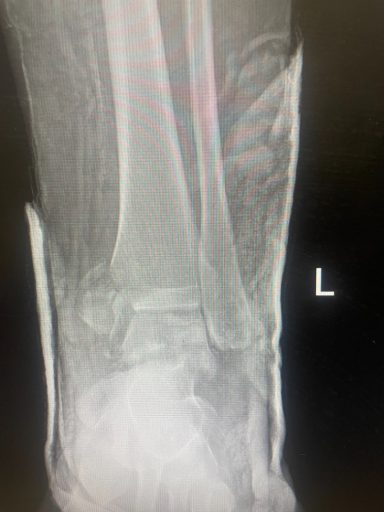
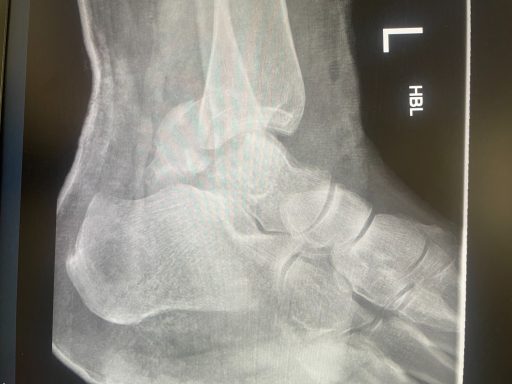
An ankle fracture is any break or crack in one or more of the bones that form the ankle joint. Mr Hester treats the full spectrum, from simple to complex injuries, at King's College Hospital Major Trauma Centre.
Symptoms
- Pain, swelling or bruising around the ankle
- Difficulty or inability to put weight on the foot
- A visible deformity, or the ankle sitting at an odd angle
- In an open (compound) fracture, a wound with the bone exposed or close to the surface
The NHS advises going to A&E if the ankle is at an odd angle, a bone is sticking out, there is a bad wound, the pain is severe, or the toes look blue or white or feel numb. Do not drive yourself.
Non-surgical treatment
Non-surgical treatment is suitable for stable, non-displaced fractures. It includes pain relief, rest, elevation and immobilisation in a cast or boot, depending on how stable the fracture is. For simple fractures of one side of the ankle (unimalleolar fractures) treated without surgery, NICE NG38 advises immediate weight-bearing as tolerated, orthopaedic follow-up within 2 weeks if there is any doubt about stability, and review if symptoms are not improving 6 weeks after the injury.
Casting can also be a reasonable option for some older adults with unstable fractures. The UK AIM trial (Willett et al., JAMA 2016) randomised 620 adults over 60 to surgery or close contact casting. Ankle function at 6 months was equivalent. Infection and wound problems were more common after surgery (10% vs 1%), while poor bone alignment (malunion) was more common after casting (15% vs 3%), and 19% of the casting group went on to have surgery. The right choice depends on your health, skin, bone quality and the fracture itself.
When surgery helps
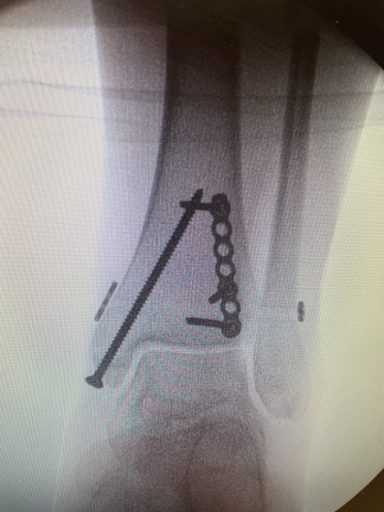
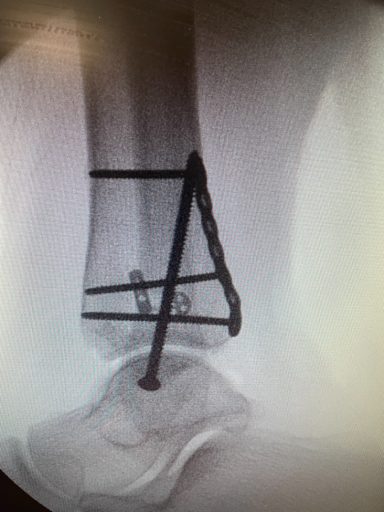
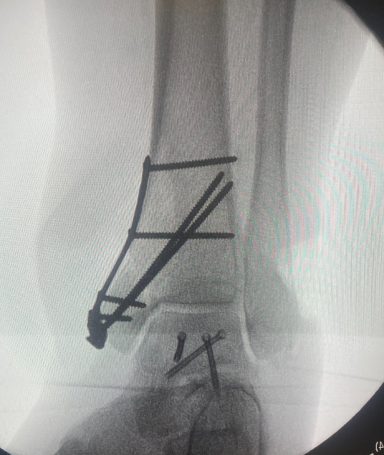
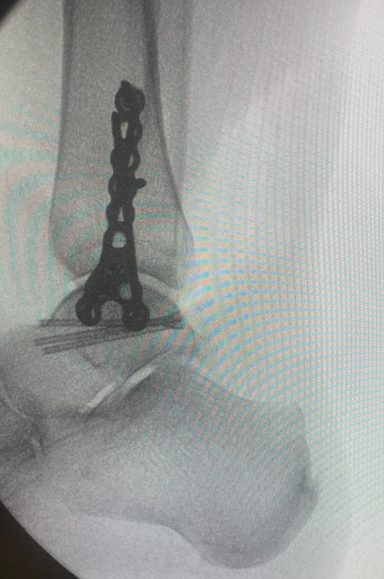
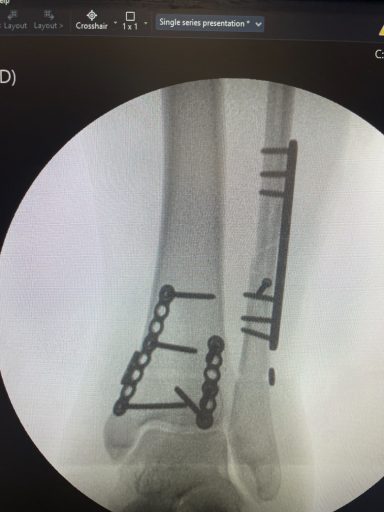
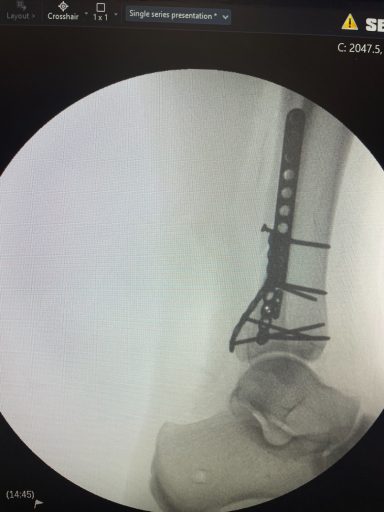
Surgery is required if the fracture is displaced or unstable. The surgical approach and fixation method depend on the fracture pattern and which bones are involved. Plates, screws or other fixation devices may be used to realign and stabilise the fracture. NICE NG38 suggests that, when surgery is needed, it should be considered on the day of injury or the next day, although marked swelling sometimes means waiting for the soft tissues to settle.
Risks include infection, nerve or blood vessel injury, blood clots, stiffness, poor healing and further surgery, such as removing metalwork. They are discussed individually before surgery.
People with diabetes need particular care. NICE guidance on diabetic foot problems (NG19) warns that a foot or ankle fracture in someone with diabetes may progress to Charcot arthropathy, so closer follow-up is important.
Recovery timeline after surgery
This is a typical pathway; your plan is confirmed at each review.
- Weeks 0–2: a temporary cast, strictly non-weight-bearing. Keep the leg elevated with the toes above the level of the nose, ideally for 55 minutes out of every hour. Crutches, a knee scooter or an iWALK hands-free crutch help you get around.
- At 2 weeks: if possible, the cast is changed to a boot so that desensitisation and scar care can begin. If a boot is not yet appropriate, a further cast is used until week 6.
- At 6 weeks: the cast is removed and you move into a short surgical boot or a Vacoped boot, depending on the surgery.
- Physiotherapy: starts as soon as the limb is accessible, at either 2 or 6 weeks.
- Exercise: core and upper-body work from as early as week 2, with nothing through the injured limb; cross-trainer, static bike and swimming from 6 weeks; running and jumping normally from 12 weeks.
- Longer term: improvement can take up to 18 months to reach a new baseline. Swelling typically lasts 9 to 12 months, and some swelling often persists lifelong.
As a guide, people return to seated work at 2–3 weeks, standing work at 6–8 weeks and heavy lifting at 6 months. Do not drive in a boot or cast.
How Mr Hester can help
Mr Hester is a dual fellowship-trained foot and ankle surgeon (FRCS Tr&Orth) and Consultant at King's College Hospital, one of only four Major Trauma Centres in London. He chairs the AO Trauma Foot & Ankle Course for AO UK and is Site Principal Investigator at King's for the NIHR TiLLI trial, which is studying blood-clot prevention for people whose lower leg is immobilised.
Private appointments are available at The London Clinic, Cromwell Hospital, King Edward VII's Hospital and HCA The Shard, and NHS care is at King's College Hospital. Insured patients need a GP referral and an authorisation code from their insurer; self-pay patients are welcome. To book, call 020 7046 8004.
Frequently Asked Questions
Sources
- Broken ankle. NHS. https://www.nhs.uk/conditions/broken-ankle/
- Fractures (non-complex): assessment and management (NG38). NICE, 2016. https://www.nice.org.uk/guidance/ng38/chapter/Recommendations
- Willett K, et al. Close Contact Casting vs Surgery for Initial Treatment of Unstable Ankle Fractures in Older Adults: A Randomized Clinical Trial (AIM). JAMA, 2016;316(14):1455-1463. https://pubmed.ncbi.nlm.nih.gov/27727383/
- Diabetic foot problems: prevention and management (NG19). NICE, 2015 (updated). https://www.nice.org.uk/guidance/ng19/chapter/Recommendations
Items patients often find useful in the first two weeks. Always follow your surgical team's instructions; these are general suggestions, not medical advice. As an Amazon Associate I earn from qualifying purchases.عناصر يجدها المرضى مفيدة غالباً في الأسبوعين الأولين. اتبع دائماً تعليمات فريقك الجراحي؛ هذه اقتراحات عامة وليست بديلاً عن المشورة الطبية. بصفتي شريكًا في برنامج Amazon Associates، أحصل على عمولة من عمليات الشراء المؤهلة.
As an Amazon Associate I earn from qualifying purchases. These are general suggestions, not a substitute for advice from your surgical team.بصفتي شريكًا في برنامج Amazon Associates، أحصل على عمولة من عمليات الشراء المؤهلة. هذه اقتراحات عامة، ولا تغني عن نصيحة فريقك الجراحي.
See all recommended equipment on Equipment & Devices.
To discuss your condition with Mr Hester, please get in touch to arrange a consultation.لمناقشة حالتك مع السيد هيستر، يرجى التواصل معنا لترتيب استشارة.
Book a Consultation